
Part 1: The existing landscape
Elizabeth (Libbie) Evans and Graeme Johnston / 12 November 2025
Originally published on LinkedIn
In recent months, the two of us have been discussing the entrenched problems of
- Continuing pressures on corporate legal departments to reduce legal spend and improve its predictability, but also on law firm partners to maintain or increase profitability.
- A widening gap between legal fees and perceived value.
- Existing approaches which only help to a limited extent and are in some respects in conflict.
We’ve written this article to summarise the nature of the main problems as we see them, and to suggest what’s working and what’s not, and how to make progress realistically.
1. Three parts
In this first part of the article, we address current practices and the challenges they present.
In the second part, we’ll suggest what we call a ‘grand bargain.’ This involves in-house legal teams and law firms doing things differently in ways which we believe can benefit both rather than being a zero sum game.
The third part will contain some practical tools and examples to help make the suggestions more concrete.
2. Context and scope
We have sought to approach the topic with the interests and perspectives of both law firms and clients in mind, rather than framing it as just about, say, pricing (law firm language) or spend management (corporate legal language).
But to keep the article focused and of reasonable length, we’ve focused it on the needs of sizable businesses and other big organisations, as opposed to SMBs and individuals; and, on the other side of the fence, on law firms as opposed to ALSPs and tech companies.
Much of the article focuses on the challenges of handling matters with a significant degree of unpredictability which can’t be covered by highly standardised (e.g. rule-based) flows. These tend to be the source of some of the larger and more difficult-to-control issues in this area. As shorthand, we’ll use the word ‘complex’ for this sort of matter.
3. Two main lakes
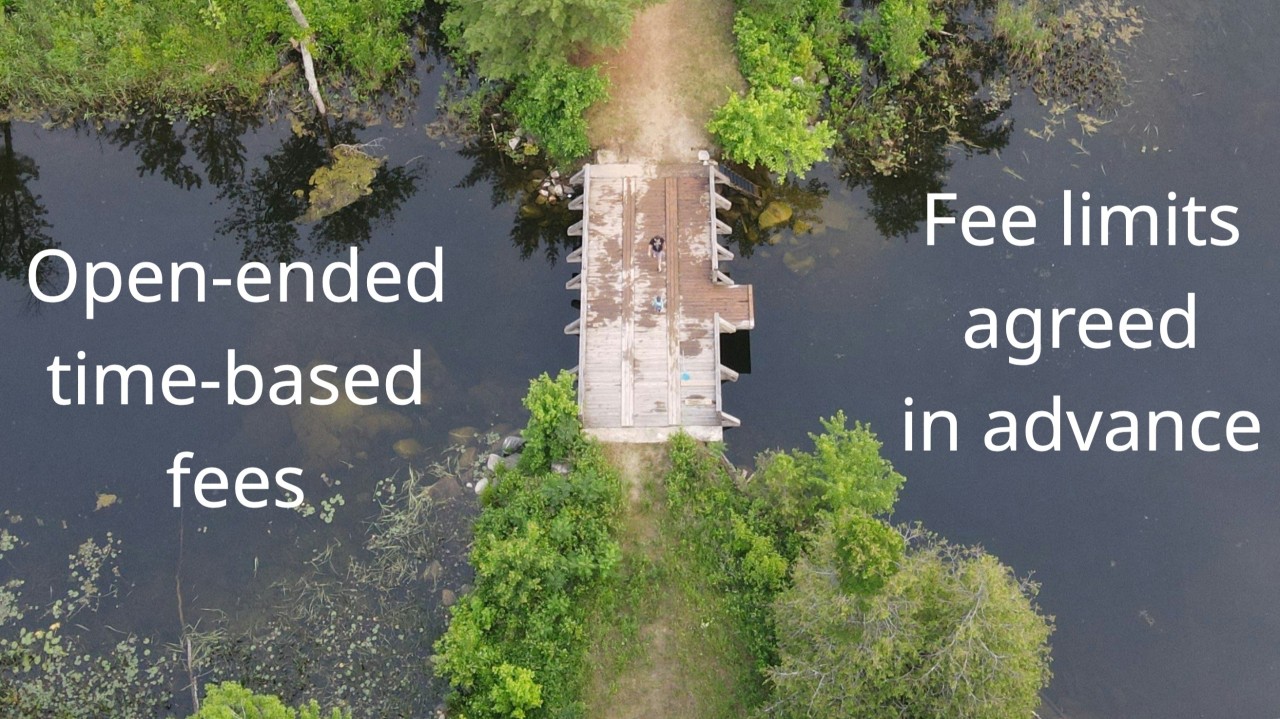
Pricing approaches for large complex corporate legal matters may be thought of as two main lakes.
Lake 1: Open-ended time-based billing.
This includes:
- Just accepting what’s billed without serious constraint or challenge (e.g. because it’s seen as immaterial).
- Challenging particular items in bills — whether they should have been done, and how efficiently they have been done.
- Adopting contractual constraints (‘outside counsel guidelines’) and seeking to apply those to bills in addition to challenging particular items on more qualitative grounds.
- Different approaches to establishing hourly rates e.g. blended rates for different levels of seniority, discounts based on volume of fees in a particular matter or wider relationship.
- Adjustments involving an element of success fee or risk-sharing (a bonus or rate uplift in the event of a result welcomed by the client; an abort fee or rate discount in the event of an unwelcome result).
Lake 2: Fees with limits agreed in advance.
This includes:
- Flat fees covering an entire matter, or part of it, with scope and assumptions designed to provide a high level of assurance that this will actually be so.
- Caps on time-based fees in a similar ‘entire matter’ situation. These may be thought of as a one-way flat fee, in the client’s favour. Some clients like them as they provide assurance against ‘over-paying’ if a project is wrapped up quicker than expected. Law firms can be less keen, given the one-sided nature: sometimes a ‘collar’ (minimum price) may be sought to balance it, though in our experience this isn’t very common in practice [n1].
- Flat fees for handling small pieces of work, or for handling a defined type of work for a period. If the latter, there will often be volume- or other formula-based variations. For either type, there will typically be regular reviews and adjustments. Also known as retainers or subscriptions.
In making this distinction, we recognise that open-ended time-based fees are often adjusted after the event to depart from the time-spent formula, usually downwards. Open-ended does not mean unlimited, or a blank cheque. But we believe the distinction between limits imposed after or before the work is done is important.
Fees based only or mainly on a percentage of transaction or claim value, or on some subjective assessment of value — are not typical in the large complex business legal services context, though may occasionally be encountered [n2].
4. Relative prevalence
It is difficult to pin down how organisations actually operate in terms of the percentage of legal spend between these two main lakes, let alone the variants within each.
- Many surveys don’t even attempt to measure this directly, and those that do are difficult to interpret with confidence, given the variations in terminology and reporting across organisations.
- Definitions are often missing or overlapping.
- Both in surveys, and within a single legal department, there may be a practical gap between how pricing approaches are described and how matters actually run. This is not a matter of deliberate misreporting. It reflects the way complex work unfolds. A matter may begin under an agreed flat fee, with this being recorded in software, but as scope evolves, the parties may revert to time-based billing for later stages. The result is that even within a single corporate legal department, the claimed percentage of spend under alternative fee arrangements may overstate how much spend is actually governed in that way during delivery.
These factors make the reality impossible to assess with confidence across entire markets. But, so far as we can tell, open-ended time-based fees still appear to account for the majority of corporate legal spend in North America. Probably a bit less so in the UK, though still highly significant [n3].
The position is variable in other places, but time-based billing is in our experience generally significant for large complex business law work.
Prevalence certainly varies between types of legal work and law firm, with more complex and high-stakes work tending more towards more open-ended fees.
5. Challenges of open-ended time-based billing
For open-ended time-based billing, a central problem is that meaningful review of work — what’s necessary or reasonable, and what should be handled differently — only happens after the work is complete.
By then, the time-driven and other costs have already been incurred by the law firm, leaving limited room for the client to say credibly, ‘we didn’t need that piece’ or ‘we could have done that in-house.’ Trimming the bill more than a small % after the fact is unrealistic once the time has been spent, as law firm partners need to meet a certain level of realisation and margin to stay in business. Pressing for major reductions after the event poses a significant risk to the ongoing relationship.
At the root is a structural misalignment of incentives. When open-ended billable time is the primary revenue model, firms are rationally motivated to generate and record time-based work or, at least, not highly motivated to find ways to reduce it. This doesn’t imply unreasonable or unethical behaviour, but the model rewards activity rather than planning and investment in efficiency — at odds with the client’s need for predictability and value. Without an agreed limit, there’s no natural checkpoint to prompt conversations about scope, efficiency, or value until after the work is already done.
The result is limited control over legal spend and limited predictability, creating challenges for financial planning and reporting at a time when GCs face growing pressure to demonstrate financial discipline.
Some organisations have tried to mitigate these challenges by tracking work-in-progress (WIP). This allows in principle for quicker correction of an over-spending direction of work, but is still backward-looking and doesn’t address the incentive problem.
A large proportion of corporate organisations have now adopted outside counsel guidelines, specifying limits on payment for certain tasks and services. These are fine up to a point, for example travel expenses or time spent on client entertainment. But they have often strayed into unhelpful generalisation and micro-management while not even touching the higher level issues of whether work should have been done. Also, they have tended to become more complicated and increasingly variable across organisations over time. As a result, their application involves significant time, they increasingly require specialised software and expertise and they encourage artificial work characterisation.
In short, open-ended time-based billing combines two problems:
- From the client perspective, there’s a lack of effectiveness at addressing the key issues of spend predictability and control.
- For everyone involved, there’s a costly, distracting process.
Increases in the scope and complexity of e-billing tools and OCGs have not solved this and in our view are not going to do so.
6. Up-front flat fees are part of the answer
A flat fee (which we’ll treat here as synonymous with fixed fee) is one agreed in advance of work being done, for a defined scope. For the purpose of this article, we include capped fees within the notion of flat fees.
A flat fee should come with reasonably clear, though succinct, assumptions and an agreed process for variation if scope is exceeded or assumptions are not met.
Such fees are a great fit where there is a strong expectation that work will be within scope and assumptions will be met, so that the sum originally agreed is almost always what is in fact paid.
This scenario also lends itself to competitive bidding and benchmarking, which are of obvious benefit to clients, though competitive bidding can create some unhappiness at the law firm end (given the transactional costs of participating and the sense of being hammered down on price) and, if not done well, lead to some relationship damage and tactical reactions such as artificial descoping.
We think there’s considerably further to go with the approach of agreeing up-front flat fees, as there is progress to be made with predictability. But this approach is not going to cover all kinds of legal spend conducted with significant human involvement.
For relatively modest engagements, the time required to scope with a degree of precision is not justified. That’s fine and need not be discussed further.
The much more important limitation is for complex work, where the unpredictability of the work more than a fairly short stage ahead makes it futile to define meaningful scope and assumptions beyond that stage. When initial scope has been exceeded or when assumptions haven’t been met, parties often revert to time-based billing. The flat fee provides predictability for an initial phase but doesn’t solve the broader challenge of managing spend across the full life of uncertain, evolving matters.
7. The contribution and limits of value-based pricing
By value-based pricing (VBP), we mean setting fees primarily by reference to the ‘deliverables’ or ‘outcome’ or ‘results’ which the client needs or wants, rather than by reference to the time and other cost expended.
The concept carries different emphases depending on the audience.Those promoting VBP to law firms tend to emphasise the subjectivity of value, suggesting that a greater focus on the particular client’s wishes can support high margin even as underlying delivery costs fall. Some even position VBP as a way of increasing pricing, coaching lawyers to show greater confidence in the value of what they provide. In contrast, those promoting VBP to corporates tend to emphasise reducing spend, and discussion of it sometimes blurs the concept with ‘value for money’ including the negotiation of lower hour rates [n4].
We agree that deliverables ought to be central in the definition of scope and pricing; and there are certainly some differences between what different businesses value. But we think the cost of delivery, including the cost of lawyer-time, is likely to remain highly relevant in setting law firm pricing for complex business work, even when the pricing model is something other than open-ended hourly fees.
We base this expectation on these points.
- Data maturity is improving, and likely to be acted upon. While there is still a lot of hard work to do, we think it is likely that legal services for businesses will over the next few years see greater data maturity on the client side. With better insights into matter deliverables, process and effort required, business clients will be better positioned to negotiate pricing using meaningful comparators about previous work effort and spend. Much of the ‘subjectivity of value’ emphasised by some law firm consultants is more a reflection of information asymmetry than of an informed choice. As that asymmetry narrows, the link between effort and pricing will become harder to obscure
- Effort will remain a reasonable baseline. Clients have long assessed the reasonableness of pricing by reference to effort. Clients who value their law firm relationshipsThey understand that law firms need to remain viable by offering competitive pay to skilled professionals, and they believe that quality work ought to be rewarded. And hours reasonably spent are understood as a proxy for effort. It is more meaningful to compare matters of equivalent scope and complexity by reference to the hours spent and distribution of those hours, than to compare (1) $ or £ sums charged overall or (2) a subjective freestanding concept of value separated from cost. The existing problems are not so much with that principle as with the way that the expenditure of time has become excessive and largely outside the client’s ability to forecast or influence.
- Technology won’t replace the law firm revenue model. There is going to be understandable client resistance to paying law firms substantial amounts (comparable to those currently paid for lawyers’ work) for technologically-delivered value. In so far as tech helps to reduce the overall cost of delivering work that a firm’s lawyers are handling, that will be reflected in the pricing of lawyers’ time. And insofar as law firms monetise their knowledge through technology platforms which don’t require much lawyer time, that’s all fine, but it won’t generate anything like enough revenue to substitute for lost junior lawyer hours, particularly once the cost of developing, maintaining, and supporting those platforms is taken into account. Law firms don’t have a sustainable monopoly on relevant knowledge and aren’t going to have a lock on the kind of technology that can aggregate and deliver it more effectively.
- Time will remain central to law firm economics. It has been accepted for a long time now that allocating all of a firm’s costs (including overhead) to lawyer time is the ‘least worst’ practical option for managing a law firm’s finances effectively, whatever pricing methods are used [n5]. On the assumption that lawyers remain the main element of a firm’s revenue-generating cost base for complex business law work, that seems to us likely to continue to be the case. Time will remain a really important part of the equation when judging the acceptability of a flat fee for such work.
8. Conclusion
For the reasons above, we think that pricing for complex legal work will likely remain strongly connected with the lawyer time involved in delivering it, even though the amount of time spent on specific tasks will change.
The central question in our view is whether the lawyer time incurred in delivering matters can be better understood, anticipated and controlled in future than it is now, in ways which give both clients and law firms what they need financially: better affordability and predictability on the one hand, acceptable margin on the other.
We think there is a realistic way of getting there, but it requires both sides to adjust how they work together in tangible ways, rather than relying on general principles or broad intentions. In the second part of the article, we describe this “grand bargain” in which predictability improves for clients and firms retain sustainable margin.
Endnotes
[n1] By cap and collar here, we mean the ‘hard’ versions, i.e. that time-based fees will be a minimum of x and a maximum of y. There is also a ‘soft’ version, with a discounted rate for fees above y and an enhanced rate for fees below x. Assuming that the discount is fairly modest (e.g. 5, 10, 20% as opposed to 70, 80, 90%) a ‘soft’ cap falls into the time-based fee lake as rates are commonly set high in order to cope with that sort of discount.
[n2] A high profile example in 2023 was a $90m success fee agreed between the board of Twitter and its then law firm, Wachtell, Lipton, Rosen & Katz, in respect of the latter’s successful enforcement of Elon Musk’s agreement to buy Twitter. That was an unusual case as time-based billing had previously been agreed (for which the fees would have been around $15m) but the board agreed and paid the much larger fee after the acquisition result was known and only shortly before the transaction closed. When it closed, Musk immediately fired the board and challenged the fee as involving a conflict of interest and breach of fiduciary duty. The dispute was sent to arbitration rather than being litigated in public.
[n3] See for example these three Thomson Reuters surveys: (1) 2025 global corporate legal (page 22, figure 16) – (2) 2025 UK legal market (page 9 / figure 5) – (3) 2025 US legal operations (figure 10). For discussion of the first two, see this post and for the third, see this post.
[n4] For the history, see this article.
[n5] See this 2025 example of VBP being suggested as a way to reduce spend significantly. For the blurring point, see pages 21-22 of this large 2025 survey by Thomson Reuters in which in-house lawyers are asked about use of ‘value-based billing’ instead of ‘hourly rates’ but the accompanying quotations ‘value’ emphasise the seeking of lower hourly rates.